Legal Work Is a Planning Problem, Not a Question Answering Problem
Over the past two years most legal AI tools have been built around a simple interaction model.
A lawyer asks a question, the system answers it.
- What does this clause mean?
- Summarise this contract.
- What risks appear in this agreement?
Large language models are extremely good at this style of interaction. They generate fluent responses and can analyse large volumes of text quickly. As a result, much of the legal AI market has evolved around systems that sit on top of documents and respond to questions about them.
The difficulty is that legal work rarely begins with a question.
It begins with an objective.
- Close a transaction.
- Resolve a dispute.
- Navigate a regulatory investigation.
- Implement a corporate restructuring.
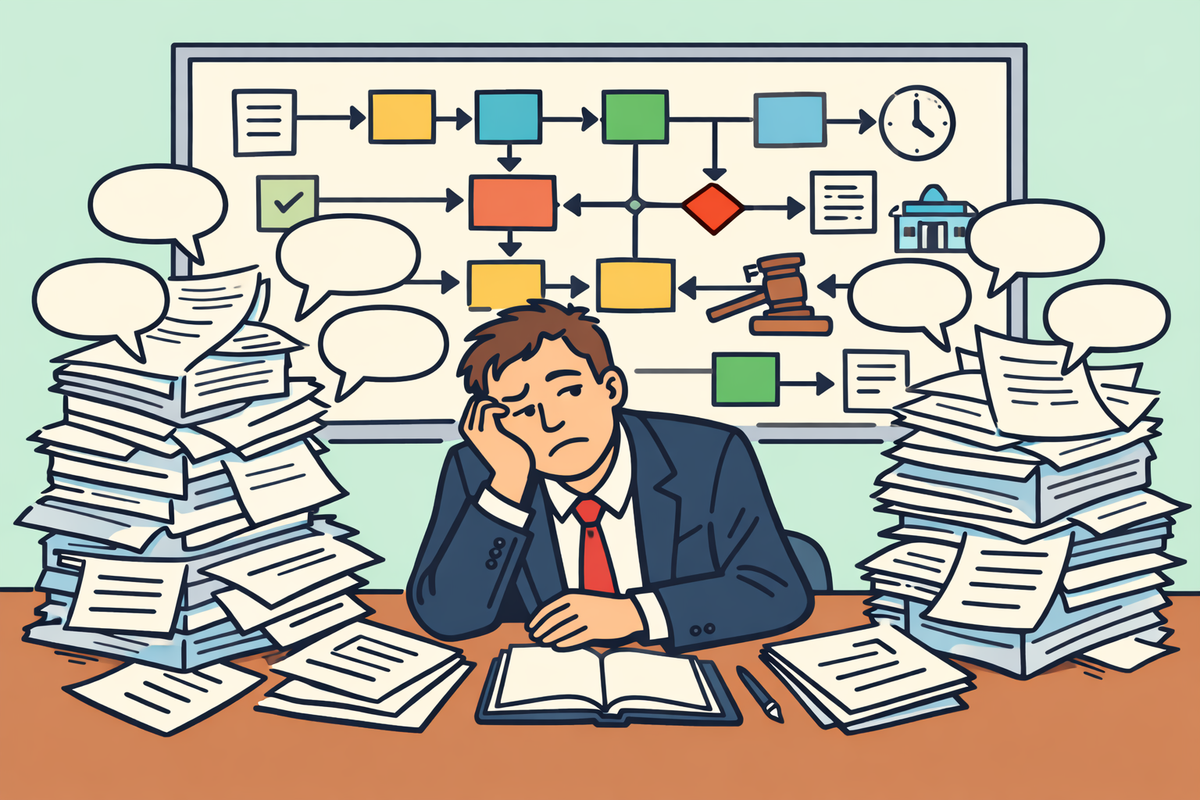
Once that objective exists, then the real work begins. A lawyer is not just a document reviewing machine, they construct and manage a plan.
Legal Matters Are Structured Workflows
Consider something routine for many corporate legal teams: a cross-border acquisition.
The legal challenge is not simply understanding the contracts involved. It is coordinating a sequence of steps that may include regulatory approvals, due diligence, negotiation of transaction documents, tax structuring and closing mechanics.
Each step depends on others, some activities can run in parallel, while others must wait until specific conditions are satisfied.
An experienced lawyer approaching this matter is not repeatedly asking isolated questions about individual documents. Instead they build a structured understanding of the work:
What needs to happen, in what order, under which constraints and with what risks.
In practice, this is planning and the lawyer continuously updates the plan as new information emerges during the matter.
The Structure of Legal Work Is Already Known
Before discussing agent systems, it is important to recognise something about legal practice that is often overlooked in technology discussions.
The structure of many legal tasks is already well understood.
Take something as routine as a statutory merger in the UK. While every transaction has its own nuances, the broad structure rarely surprises experienced lawyers.
There will typically be steps such as:
- Reviewing authorities
- Preparing merger documentation
- Assessing regulatory requirements
- Coordinating filings with Companies House
- Notifying stakeholders
- Managing completion mechanics
These are not hidden tasks waiting for AI to uncover them, they are part of established professional practice.
Even the sub-tasks are usually clear. Lawyers know the approvals that must be obtained, the filings that must occur and the documents that must be prepared.
If a legal team cannot articulate the high-level structure of the work, introducing AI agents will not solve that problem, it will simply expose the shambles.
Why Document-Centric AI Feels Incomplete
Most current legal AI tools operate at the document level.
They summarise agreements, extract clauses, identify obligations or answer questions about specific provisions. These capabilities are genuinely useful and remove a considerable amount of manual work.
However they address only part of the legal task.
Understanding documents is rarely the end goal of a matter, but it is just one component of a broader process. A system that can explain a clause still leaves the lawyer asking the more important question: what should happen next?
That is where the limitations of a purely question answering model become visible.
It is also worth recognising that there is a genuine duality here. In many workflows the goal really is an ideal document. Contract drafting, regulatory filings or template generation are often judged by whether the final document meets a defined standard and in those cases a document-centric model works extremely well.
The limitations appear once the work is no longer defined by producing a document but by navigating an evolving process.
Where AI Actually Changes the Equation
The real opportunity for AI does not lie in identifying the standard workflow. Lawyers already understand the shape of the work.
The opportunity lies in managing how that workflow evolves as the matter progresses.
Legal matters rarely proceed exactly according to the initial plan.
- A regulatory authority raises an unexpected concern.
- A diligence finding reveals a contractual restriction.
- A counterparty introduces new negotiation conditions.
- Or maybe a filing deadline changes.
Each of these developments has downstream consequences. Tasks may need to be reordered, expanded or reconsidered entirely.
One interesting side effect of systems that attempt to execute these plans is that they often expose inconsistencies in the underlying requirements. When a workflow is forced to run step by step, assumptions that exist in the heads of stakeholders become visible.
A process may depend on information that does not exist. A data model might assume a single record where reality produces many. In this sense, planning systems do not just execute legal workflows, they reveal where those workflows were poorly specified to begin with.
Today this adjustment largely happens in the lawyer’s head, supported by emails, spreadsheets and hopefully some project management tools.
An agentic system could operate very differently.
Instead of simply executing predefined steps, the system could continuously monitor the matter and update the plan as new information appears.
- A regulatory concern could trigger additional review steps.
- A diligence finding could introduce new workstreams.
- A negotiation concession could alter downstream documentation or approvals.
The structure of the work remains the same. What changes is the system’s ability to adapt as the matter evolves.
From Document AI to Process AI
Seen through this lens, the next stage of legal AI development is unlikely to be defined by better document summaries or more accurate clause extraction.
Those capabilities will continue to improve and will likely become standard components of legal systems. The more significant change will occur when legal AI moves from analysing documents to managing processes.
Instead of asking a system to interpret individual provisions, a lawyer might begin with the matter objective itself.
Let's say we have the following objective: Plan the steps required to complete the acquisition of this subsidiary.
A sufficiently capable system could then:
- Identify relevant regulatory regimes
- Analyse key contracts
- Generate a structured task plan from template
- Highlight dependencies between steps
- Monitor obligations and deadlines as the matter progresses
Document analysis becomes one capability within a larger planning framework.
Legal Needs a System of Record for the Work
Other industries solved this problem long ago by introducing systems of record for the work itself. In software engineering, every task is tracked in tools such as Linear or Jira. These systems do not just store code. They track the state of the work, the dependencies between tasks and the history of decisions made along the way.
Legal practice rarely operates this way. Matters are coordinated across emails, documents and informal trackers. As document AI increases the volume of work a single lawyer can handle, this model becomes fragile.
All this because the associate who once reviewed a few agreements per day may now oversee dozens. Maintaining situational awareness across that workload becomes difficult without a system that understands the structure of the matter.
Now when these systems were first introduced in engineering, they were met with resistance. Developers complained that they had to write the code and then update another tool to say the work had been done and it all felt like unnecessary overhead.
Over time that friction largely disappeared as automation improved. Code commits began updating task trackers automatically. When a change moved into a testing branch, tools could update the ticket status, attach deployment details and notify reviewers without manual intervention.
A similar pattern is likely to emerge in legal systems of record. The status of a matter should not depend on someone manually updating a tracker. Email activity, document changes, filings and approvals could all update the state of the work automatically. Instead of maintaining the plan, the system observes the work and keeps the plan current.
How Legal Teams Can Start Approaching This
Moving from document analysis to planning systems does not require a complete reinvention of legal technology. In practice it begins by recognising that the most valuable asset is not the documents themselves but the structure of the work around them.
Make legal workflows explicit
Many legal teams operate with well understood processes that are rarely written down in a structured way.
Defining the phases of a matter, the sub-tasks within those phases and the dependencies between them creates something technology can interact with.
Without that structure, AI systems are left guessing and that way chaos lies.
Separate planning from document analysis
Most tools treat documents as the centre of the system, but planning systems invert that relationship.
The matter becomes the primary object and documents are just inputs that inform the plan.
Use AI to detect change
One of the most useful early applications of AI is identifying when the assumptions of a matter have changed.
Draft updates, diligence findings, regulatory developments or client communications can all trigger adjustments to the workflow.
Instead of waiting for a lawyer to ask a question, the system surfaces these signals automatically.
Treat matters as living systems
Legal matters evolve over time, yet most technology treats them as static collections of documents.
Planning systems treat matters as living structures that continuously update tasks, dependencies and risk indicators.
Start with a structured use case
This approach works best in areas where workflows are already well defined.
Corporate reorganisations, regulatory filings, internal investigations and standard transaction processes are good starting points.
The Legal Planning Stack
Once legal AI evolves beyond essentially document chat interfaces, the architecture of legal technology may begin to resemble a planning system rather than a document repository.
In this model, document analysis does not disappear, instead it becomes one layer inside a broader system that understands the objective of the matter and adapts the workflow as information changes.
A simplified model might look like this:
Layer 5: Objective Layer
This is where the system understands what the matter is trying to achieve.
Examples:
- Close the acquisition of Company X
- Complete a statutory merger
- Respond to a regulatory investigation
Everything below this layer exists to move the matter toward that objective.
Layer 4: Planning Layer
The workflow of the matter.
This layer defines:
- Phases of the matter
- Tasks within each phase
- Dependencies between tasks
- Sequencing of legal steps
For example, a merger might include approvals, filings, documentation preparation and completion mechanics.
Layer 3: Monitoring Layer
The situational awareness layer.
AI systems monitor:
- Document changes
- Client communications
- Regulatory updates
- Filing deadlines
When something changes, the system identifies whether the existing plan needs to adapt.
Layer 2: Analysis Layer
This is where AI performs legal reasoning on the underlying material.
Capabilities may include:
- Document analysis
- Clause extraction
- Obligation identification
- Regulatory checks
- Risk analysis
The insights generated here feed into the monitoring and planning layers.
Layer 1: Data Layer
The foundation of the system.
This includes the raw information connected to the matter:
- Contracts
- Emails
- Corporate records
- Regulatory guidance
- Matter documents
Everything above this layer depends on the quality and accessibility of this data.
For the past few years the dominant question in legal AI has been straightforward.
How do we get reliable answers from legal documents?
Hopefully after reading this, you think there's a more interesting question...
How do we build systems that understand where a legal matter is going next?
Once legal AI can plan rather than simply respond, the technology begins to look less like a document assistant and more like a system that helps manage the complexity of legal work itself.
That change will not simply improve document analysis, it will change how legal work is organised, coordinated and delivered.