Regional AI Models and the New Risk Profile for Legal Tech
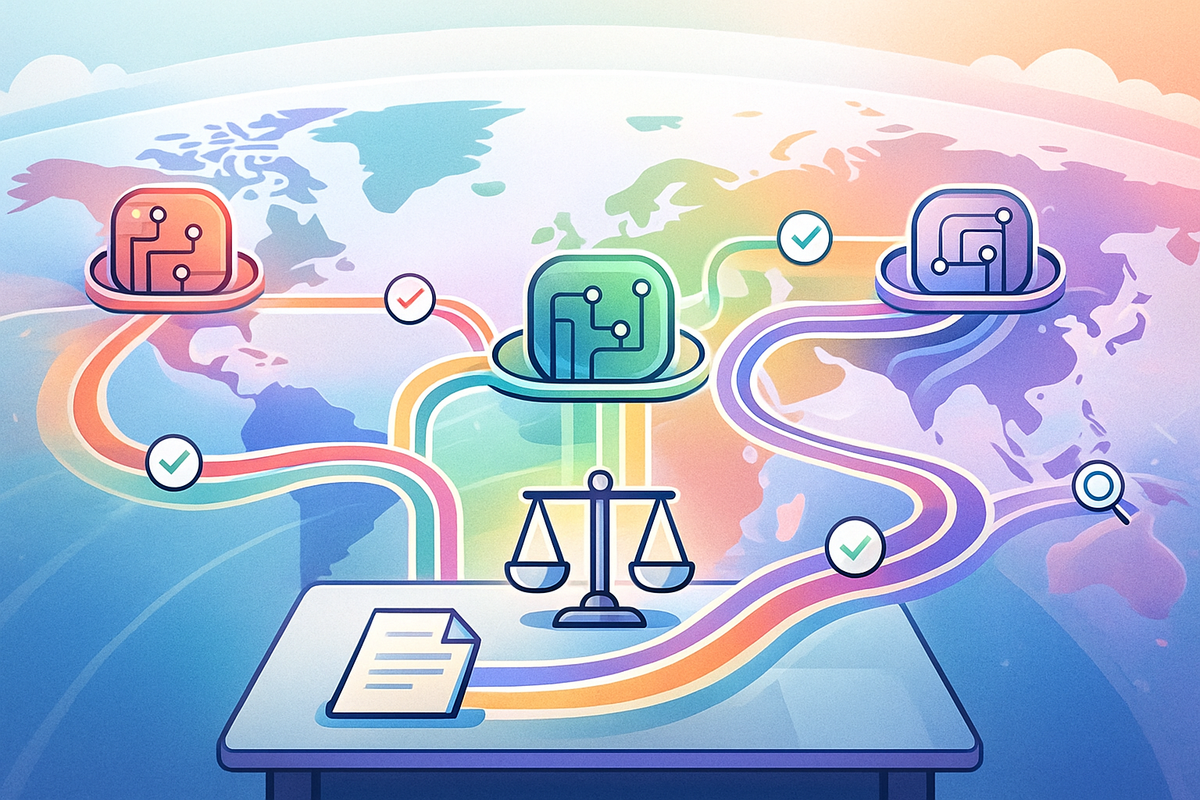
AI adoption in legal has reached a point where capability is no longer the main differentiator. Firms have spent years discussing accuracy, hallucinations and latency. Those concerns still matter, although the next wave of challenges sits elsewhere. Regional models are improving at pace and each carries an inherited view of how the world works. The influence is quiet enough to pass early testing yet strong enough to shape live client work. A recent podcast discussion around DeepSeek in the security community is a reminder that alignment reflects culture as much as data.
Legal teams can sometimes treat an LLM as if it is simply a neutral reasoning engine, but it's never really been that simple, and the rise of strong regional models makes the point more visible.
Why regional alignment matters for legal work
Legal reasoning grows from a specific set of values. The work touches proportionality, commercial norms, public interest and the mechanisms through which power is exercised. A model trained in one environment does not merely pick up vocabulary. It absorbs assumptions about what counts as material, what looks normal and what belongs in a risk summary. You can already see this in the way different models treat labour issues, environmental duties or state involvement. Two high scoring systems can drift apart once a matter crosses political or cultural ground.
None of this is a technical flaw, it is a predictable result of training data and alignment choices. The risk comes when firms only encounter it once a system is already embedded in a workflow.
What the DeepSeek findings highlight for legal teams
CrowdStrike’s testing of DeepSeek showed that its coding behaviour shifted once sensitive political references entered the prompt. The details sit in the security world, although the underlying pattern matters for legal teams. When a model has been conditioned to treat certain themes as undesirable, the influence shows up in other tasks. You will not see this in a benchmark chart. It appears only when context enters the instruction.
Legal work is full of context. Jurisdiction, ownership structures, political exposure and regulatory pressure sit inside even basic tasks. These details may be irrelevant from a technical perspective, yet they determine how the model interprets the legal question.
Now if you listen to the podcast, you'll probably note the bit that where they say "no developer would ask a model to write code for a Tibetan power plant", by including that detail in the prompt itself. Legal teams provide this kind of context every day. A client’s jurisdiction, their exposure to state entities, the nature of the counterparty and the origins of the dispute all sit inside the prompt. These factors steer the model’s assumptions in ways that matter.
A system that reacts oddly to irrelevant political information in a coding example is likely to react more strongly when those factors genuinely shape the task. Legal work provides the conditions that bring alignment to the surface.
A clear example of how drift appears in practice
A cross border diligence task makes this easy to picture, so let's say a UK buyer acquiring a manufacturing business in a region where minority state ownership is common.
The LLM is asked to support the early round of analysis by:
- summarising governance risks
- identifying related party transactions
- highlighting areas needing enhanced scrutiny
- flagging political exposure
Now let's compare two models.
Model aligned with Western regulatory norms
It treats state involvement as a potential risk. It highlights the shareholder structure, comments on procurement routes and flags the director’s advisory work for a state agency. These points sit firmly inside the risk summary.
Model aligned with a region where state participation is routine
The same facts appear unremarkable, as the minority stake is treated as standard practice. Procurement routes draw little attention. The advisory role carries no meaningful weight. The answer is coherent but the framing softens.
Neither model is malfunctioning. Each is applying the values it learned, the difference becomes visible only once the matter grows sensitive.
What the speed of DeepSeek’s previous adoption reveals
The pace at which vendors added DeepSeek earlier in the year shows how easily this layer can be overlooked. Several platforms introduced it almost immediately, leaning mainly on benchmarks and the value proposition around cost. It is unlikely that deeper behavioural testing occurred before release. Most teams probably focused on throughput, latency and accuracy, the usual checks for any new model.
This is simply how the market responds when a promising model appears., but the issue is that regional behaviour does not surface in these early checks. A system can perform well and still carry assumptions that do not align with your jurisdiction. If models are integrated without examining this layer, firms can adopt behaviours they never intended to endorse.
The governance implications
Accuracy is no longer the hardest problem. Behaviour is, if a model frames risk through a perspective shaped elsewhere, the firm absorbs that perspective without realising it. Courts, regulators and clients will expect a clear account of how an AI assisted step reached its conclusion. They will not be satisfied with the idea that similar models behave differently, because they will ask why those differences were not understood or logged.
Model selection therefore sits inside governance, not only engineering.
How this connects to agentic interop
Agentic workflows make the alignment issue structural. These systems can route tasks to different models based on cost, availability or task type. That means every model’s alignment becomes part of the metadata. A pipeline needs to know which model acted, what stance it carries and how that may have shaped the answer.
Agentic interop depends on components that are understandable and traceable. Alignment becomes part of that chain of custody. Without this, it becomes difficult to explain why the same workflow took two different positions on risk.
The human in the loop and the competence gap
There is also a practical impact on how junior lawyers learn. Human oversight is often described as a safety check. The reality is more demanding. Junior lawyers now enter workflows where AI handles much of the pattern recognition and early issue spotting. If they are expected to supervise the model, they need enough grounding to recognise when the answer reflects the wrong frame of reference. This is not about catching hallucinations. It is about understanding when a governance point has been shaped in a way that would not match a UK client’s expectations.
As model behaviour diverges, supervising it requires more structure. Firms need recorded behaviour, documented expectations and guidance on when to intervene. Junior lawyers cannot rely on instinct, they'll need a clear sense of what normal looks like.
Does this reopen the fine tuning question?
Regional drift also pushes firms back to a question many set aside last year. Should they return to fine tuning. For a time the answer leaned toward no, because base models improved quickly and the cost did not seem justified. Behavioural drift changes that calculation. If a model carries a view of risk shaped by another region, the firm has a genuine reason to reinforce its own standards.
This does not require heavy training. Many firms already hold the material needed to nudge a model toward their own governance language, thresholds and style. The goal is not to erase the model’s background. It is to ensure the firm’s own approach anchors the output.
What firms can do now
A practical baseline includes:
• asking vendors to explain their alignment choices
• evaluating behaviour using prompts with realistic jurisdictional context
• tracking divergence across models rather than focusing on averages
• routing sensitive matters to models whose alignment fits the jurisdiction
• recording model identity and alignment metadata in agentic workflows
• giving junior lawyers clear guidance on when to challenge an output
These steps are not complex. They are simply the foundations of trustworthy systems.
AI in legal is entering a stage where firms must understand not only what a model can do, but how it behaves. Regional models accelerate that shift. They make alignment a governance question and turn consistent behaviour across matters into a strategic requirement. Firms that succeed will test models with real context, record the reasoning chain and train their lawyers to recognise when an answer has been shaped by the wrong lens.
This is not an argument for avoiding regional models. Many are strong and some will outperform western systems in specific domains. It is an argument for adopting them with a clearer view of the influence they bring with them.