Designing the AI native firm
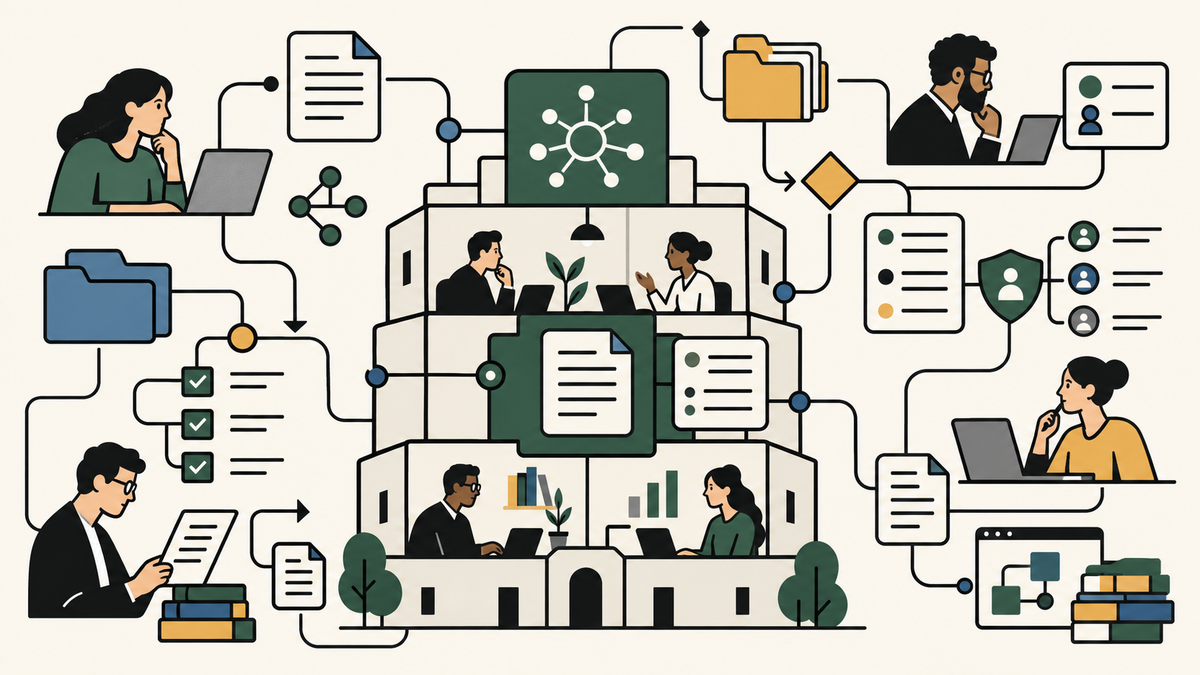
We're reaching the point where describing a law firm as "using AI" doesn't tell us very much.
Most large firms now have access to some combination of general-purpose models, legal AI products, internal tools and increasingly agentic workflows. I read recently some Thomson Reuters' research found that more than three quarters of lawyers said their firm had an AI strategy, but fewer than half felt confident that their own practice area was well positioned as AI became more integrated into legal work.
I think that gap is more interesting than the adoption figures themselves.
We've spent the last few years asking whether lawyers will use AI, which products they'll use and what work the models can perform. Those were sensible questions when we were still trying to work out whether the technology was useful enough to matter. I think we're moving into a different phase now, where the more interesting question is what happens once we assume that AI is simply going to be part of how legal work gets done.
If we start from that assumption, what does the organisation itself need to look like?
I don't think the answer is simply a law firm with more copilots, nor do I think it means putting AI at the centre of everything, I’d say it’s almost the opposite.
The firm is the system.
We've been adding AI to organisations designed for humans
Most legal technology still assumes that a human sits in the middle.
A client sends an email and somebody understands what it means, they know which matter it relates to, which documents are relevant, whether that instruction changes something previously agreed, who else needs to know and what should happen next. Which is a lot.
They might then update a matter system, save something into the document management system, message a colleague, create a task, amend a document and eventually respond to the client.
There are lots of systems involved in that process, but the lawyer joins them together. That's so normal that we barely think of it as work in its own right.
It is, though.
People inside firms are doing enormous amounts of integration every day. They resolve ambiguity between systems, carry context from one application to another, remember that a particular client wants something done differently, know which precedent is actually current and recognise when something received this morning changes a conclusion reached yesterday.
Our technology estates can remain fragmented for a long time partly because humans are remarkably good at compensating for them, AI makes that bodge of systems much more visible.
If software is going to participate meaningfully in legal work, rather than simply generate a paragraph when someone asks it to, it needs access to at least some of the structure that humans have traditionally carried around implicitly. That doesn't mean giving an agent unrestricted access to the firm, it means making the organisation itself more legible to machines.
AI-native doesn't mean AI-first
There's already a growing body of thinking around the idea of the "AI-native law firm". Some definitions make a fairly clear distinction between AI-assisted firms, where AI is inserted into existing workflows, and AI-native firms, where the work itself is designed around agents or automation from the beginning.
We're also beginning to see genuinely different approaches emerge in practice. We’ve seen Garfield be the first firm authorised by the SRA to provide legal services through an AI driven model, designing its small claims service around software doing much of the work while regulated solicitors remain accountable. Then at a very different scale, Latham & Watkins has invested in its own GPU infrastructure and open-weight models, giving it more control over models, data and the economics of inference.
Those examples look almost nothing alike, which I think is the point. Being AI-native shouldn't be defined by how much AI a firm uses or how much work it automates.
I'd define it more simply: an AI-native legal organisation is one designed on the assumption that humans and machines will both participate in its work.
Once you take that seriously, the implications spread much further than model choice.
The firm is the system
A law firm already behaves as a complex system. It contains people, clients, matters, documents, expertise, precedent, policies, permissions, processes, relationships, decisions, commercial constraints and professional obligations, all interacting with one another.
Technology only models fragments of that system.
The CRM knows something about the client. The document management system knows where the files are. The practice management system knows something about the matter. The finance system knows what has been billed. The knowledge system knows something about precedent. Individual lawyers know much of what joins those things together.
That has worked reasonably well because people provided the connective tissue.
I think an AI-native organisation has to make more of those relationships explicit. That isn’t because everything should be automated, but because a machine can't reliably participate in a system it can't understand.
It knows what is true now
Legal work isn't simply a collection of documents, it’s an ever changing state.
A client instruction received today might supersede one received last week, a transaction changes as negotiations progress and new law can make advice that was perfectly correct six months ago wrong today.
I've written before about treating matters more like evolving state than static files. At organisational scale, I think that becomes much more significant because the question isn't only whether information exists, but what status that information has.
- Where did it come from?
- When was it true?
- Is it still true?
- Who has authority to change it?
- Does it apply across the firm, within a jurisdiction, to a particular client or only to one matter?
- What superseded what?
Retrieving ten relevant documents isn't the same thing as answering those questions.
This may be one of the harder enterprise AI problems. Model capability is moving incredibly quickly but institutional truth is much messier. The difficult part is often not finding information, but understanding which information the organisation should currently trust.
Its processes are explicit
A surprising amount of legal process still lives in people's heads.
That's not necessarily because firms are badly run. Often the work contains so many exceptions, judgement calls and local conventions that trying to document every branch has never felt particularly useful. People cope with that ambiguity naturally. Machines don't.
If software is going to participate in legal work and at scale, we'll need to get much better at expressing how that work actually happens. I don't mean producing enormous process diagrams that nobody reads. I'm thinking more about executable playbooks that describe what we're trying to achieve, what information is required, which actions are possible, what counts as an exception and when somebody needs to intervene.
There's a useful side effect to this, making a process understandable to a machine often forces us to understand the process ourselves.
We might discover that something we thought required judgement is actually a repeatable rule. We may even find that a supposedly consistent process varies significantly between teams, or that a simple workflow depends on one person knowing several unwritten exceptions.
I reckon most people reading this can think of a few of the top of their heads.
Authority becomes part of the architecture
Giving AI access to knowledge is relatively straightforward, though it having an understanding of authority is much harder.
A partner's email, an old precedent, a practice note, legislation, a client-specific playbook and something written in a previous matter could all contain answers to the same question, but they clearly don't all carry the same weight.
The system therefore needs some way to understand the difference.
The same applies to actions. Being technically capable of sending an email doesn't mean an agent should be authorised to send one. Being able to generate a filing doesn't mean it can submit it or being able to identify a risk doesn't tell us who has authority to accept that risk.
That means decision rights start becoming part of the technical design.
- What can a system do by itself?
- What can it propose?
- What requires review?
- Who can approve it?
- What gets escalated, and who ultimately owns the outcome?
This is why I've become more interested in accountability than simply putting a "human in the loop". The human needs an actual role in the system, with clear responsibility and authority, rather than appearing as an approval button at the end of an automated process.
Applications become less important than capabilities
We've spent decades buying applications… of varying quality.
One for documents, one for matters, one for research, one for contracts, one for workflows, and increasingly several applications that each contain their own AI assistant.
I'm not convinced that's the long-term shape of legal technology, in fact I’m certain it’s not that case.
Take something relatively straightforward such as identifying the parties to a transaction. That capability might be useful during intake, conflicts, due diligence, drafting, entity management and billing, it seems odd that every application should need its own version of the same capability.
The same could apply to comparing clauses, checking sanctions, identifying governing law, extracting obligations, summarising evidence or classifying documents.
In that world, applications don't disappear, but they own less of the intelligence. The more durable parts of the architecture become the firm's data, knowledge, permissions, processes and reusable capabilities, while the interfaces around those things can change much more quickly.
That also makes model choice less important. A capability might use one frontier model today, a smaller specialist model tomorrow and an internally hosted model for particularly sensitive work, though the rest of the organisation shouldn't need to care.
The organisation reacts to events
There's another assumption buried in most legal software: somebody opens it.
A lawyer receives something, decides it matters, opens the relevant application and starts a process. Yet much of legal work actually begins with an event rather than an application.
- A client sends an instruction.
- A counterparty changes a document. A company enters a structure.
- A filing is made.
- A regulation changes.
- A deadline approaches.
An AI-native organisation should increasingly be capable of recognising those events and deciding whether anything needs to happen as a result.
Sometimes the answer might be to do something automatically, perhaps sometimes it will be to prepare something for review and other times the right response is simply to tell the right person that something has changed.
I think that distinction matters. An agent shouldn't need to wander around the firm's systems looking for work. The wider system should already know that something happened which may require attention.
AI itself becomes replaceable
This might sound slightly strange in an article about AI-native organisations, but I think one sign of maturity will be that individual models become relatively unimportant.
Models are improving too quickly to build an organisation around any one of them.
The enduring assets are elsewhere: the firm's knowledge, client relationships, understanding of how work gets done, specialist expertise, historical decisions, evaluation data and the controls surrounding all of that.
Latham's reported move towards a mixture of internal infrastructure, open-weight models and commercial providers is interesting for this reason. It creates optionality rather than assuming every problem should always be sent to one provider.
I'd expect mature firms to route work according to what it actually needs. Some tasks need the strongest available reasoning model. Some need speed. Some need very low cost. Some need to run locally. Some barely need a language model at all.
Being AI-native shouldn't mean becoming model-dependent, if anything, the opposite is true.
We should know whether any of this works
One uncomfortable consequence of AI participating in legal work is that firms will need to get much better at measuring quality.
Humans are surprisingly tolerant of processes where nobody really knows how often something goes wrong. AI tends to be held to a different standard and, in many ways, that's useful.
If a system reviews contracts, we should know what it misses. If it drafts something, we should know how often the work needs substantive correction. If it routes a matter, we should know how often it gets that wrong. If a five-stage AI workflow costs £20 every time it runs, we should know whether the outcome justifies spending £20.
This is why I think measures such as cost per token will become much less interesting than cost per trusted outcome.
The cheapest model isn't cheap if lawyers have to redo its work and the strongest model isn't especially valuable if its additional capability makes no practical difference. Evaluation therefore needs to become part of how the organisation operates, rather than something performed once before a product is launched.
Humans don't disappear from this picture
None of this leads me to a lawyerless law firm.
Clients still need somebody who understands what they're actually trying to achieve. Ambiguous facts need judgement, negotiation involves people, novel situations require experience and risk still needs owners. Legal organisations also need people who can recognise when the technically correct answer is still the wrong thing to do.
What I do think should disappear is some of the work humans perform simply because our systems can't do it.
Copying information between applications isn't professional judgement. Remembering which system contains the current version isn't professional judgement. Searching across six places because organisational knowledge is fragmented isn't professional judgement. Manually checking whether something has changed because nothing else is watching isn't professional judgement.
We shouldn't confuse friction with expertise.
So what does an AI-native legal organisation actually look like?
Probably less super cool and futuristic than the phrase suggests.
I don't imagine hundreds of autonomous agents negotiating with one another while lawyers wait for escalation notifications. I imagine an organisation where more of the structure of legal work is explicit, where systems understand the current state of work rather than simply storing its artefacts, and where knowledge carries provenance and authority.
I imagine processes that can be executed as well as documented, permissions that apply to machines as seriously as they apply to people, capabilities that can be reused across workflows, and systems that respond when something changes rather than waiting for a person to notice.
I also imagine firms where models can be replaced without rebuilding everything around them, where automated work can actually be measured and where humans have clear responsibility for the decisions that genuinely require them.
AI doesn't need to sit at the centre of that organisation, but the firm does.
For me, the interesting challenge isn't turning the law firm into an AI system. It's making the firm understandable enough that AI can become a useful participant in it.
That's a much bigger project than giving everyone a copilot, and I think we're only just starting it.